What is OSINT?


Leer en español →
When people ask what I do and I answer "OSINT," I usually get a blank stare. That's understandable, since it's not a term most people come across outside of intelligence, cybersecurity, or law enforcement circles.
• OSINT stands for open-source intelligence. It's the practice of collecting publicly or commercially available information, verifying it, and analyzing it to answer a specific question.
• It's an official intelligence discipline, recognized by the U.S. Intelligence Community.
• It is not hacking. If you have to break in to get it, it isn't OSINT.
In this article: You already have the instincts · What "open source" means · What makes it intelligence · Where OSINT fits · Who uses it · What it's not · Is it for you?
A little backstory
I was already using the same basic instincts OSINT is built on long before I knew what to call it. When the term finally crossed my path, I was pivoting into the cyber industry and setting my sights on digital forensics. Almost everything I read framed OSINT as a reconnaissance tool for hackers, so I wrote it off. I'm not a hacker, I thought. That changed when I attended a presentation by a police officer and OSINT practitioner, who is now a good friend of mine. He showed me what OSINT could really do, and that's where my journey officially began.
“I’m not a hacker, so OSINT isn’t for me.” That’s what I thought, until I saw what OSINT could really do.
You already have the instincts
Most of us already use the same basic instincts that OSINT is built on. Have you ever:
- Checked a contractor's license and reviews before hiring them?
- Run a reverse image search on a profile photo that felt off?
- Checked whether a viral photo was really taken where the caption claims?
- Researched a company before a job interview?
- Googled your own name?
That's the instinct, but it isn't OSINT yet. The professional version adds method: a defined question, documented sources, verification across multiple sources, and a clear statement of how confident you are in the answer. The rest of this article explains what that looks like.
What "open source" means
In intelligence, a source is simply where information comes from. An open source is one that anyone can access legally, without a clearance, a warrant, or breaking into anything. (If you work in tech, don't confuse this with open-source software. The terms sound alike, but they mean different things.)
The Berkeley Protocol, an international guide for digital open-source investigations published by the UN Human Rights Office and UC Berkeley, describes three ways anyone can get open-source information: [1]
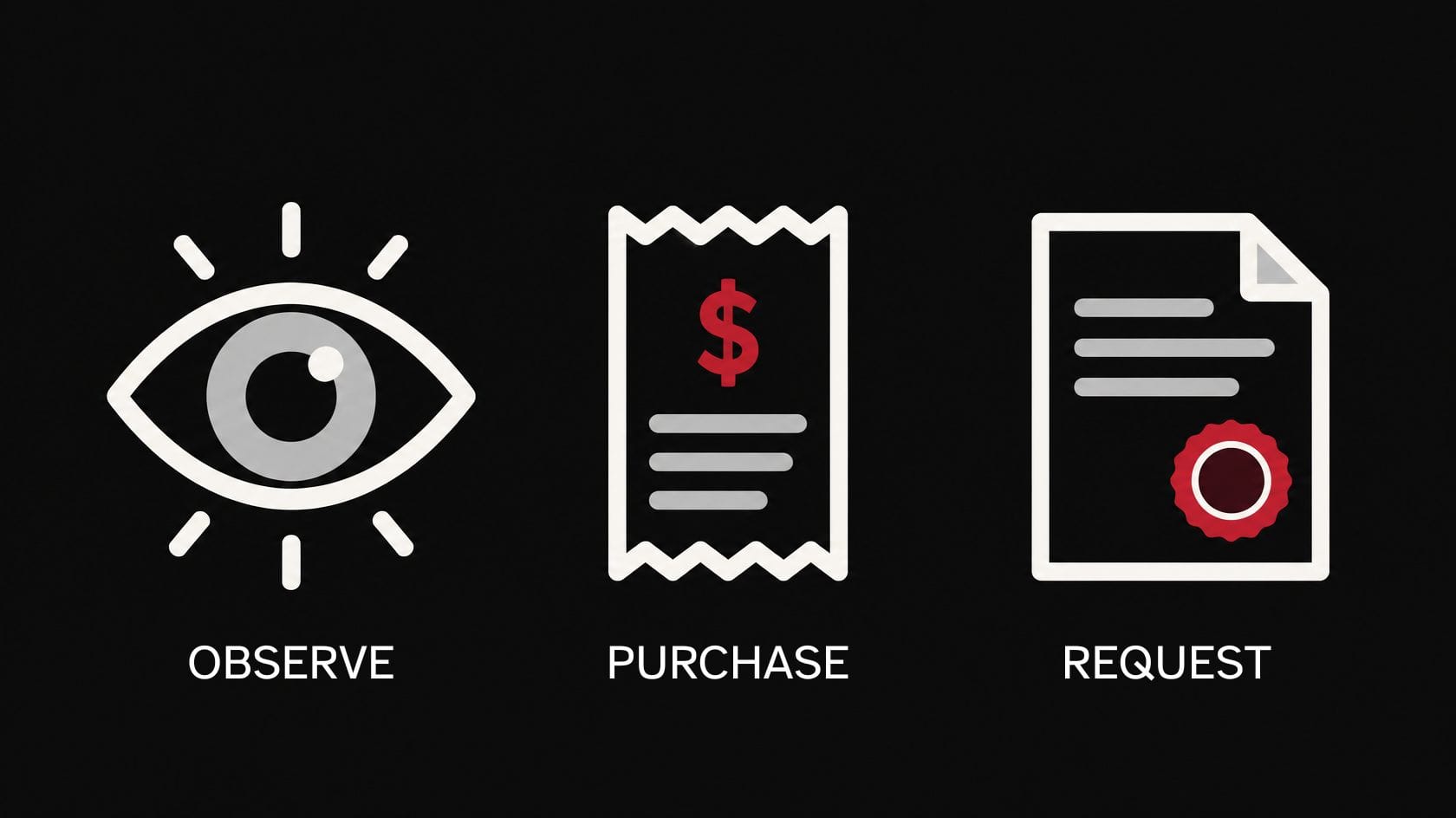
- Observe: reading a public post, watching a video, viewing satellite imagery
- Purchase: buying a subscription, a commercial dataset, or a copy of a record
- Request: filing a public records request with a government office
What makes it intelligence
Open-source information is the raw material, and OSINT is what you make from it. That difference is what separates OSINT from simply Googling something.
| Information | Intelligence | |
|---|---|---|
| What it is | Raw, unevaluated material | Material that's been verified, analyzed, and assessed |
| Example | A screenshot of a social media post | A short report on who posted it, whether it's authentic, how it answers the question, and how confident you are |
| What you can do with it | Not much yet, since no one has checked it | Make an informed decision |
The official definition: "OSINT is intelligence derived exclusively from publicly or commercially available information that addresses specific intelligence priorities, requirements, or gaps." [2]
In plain English, it comes down to two rules:
- Public or commercial sources only. Nothing classified, stolen, or accessed without authorization.
- There's a question behind it. Collecting random information isn't intelligence work.
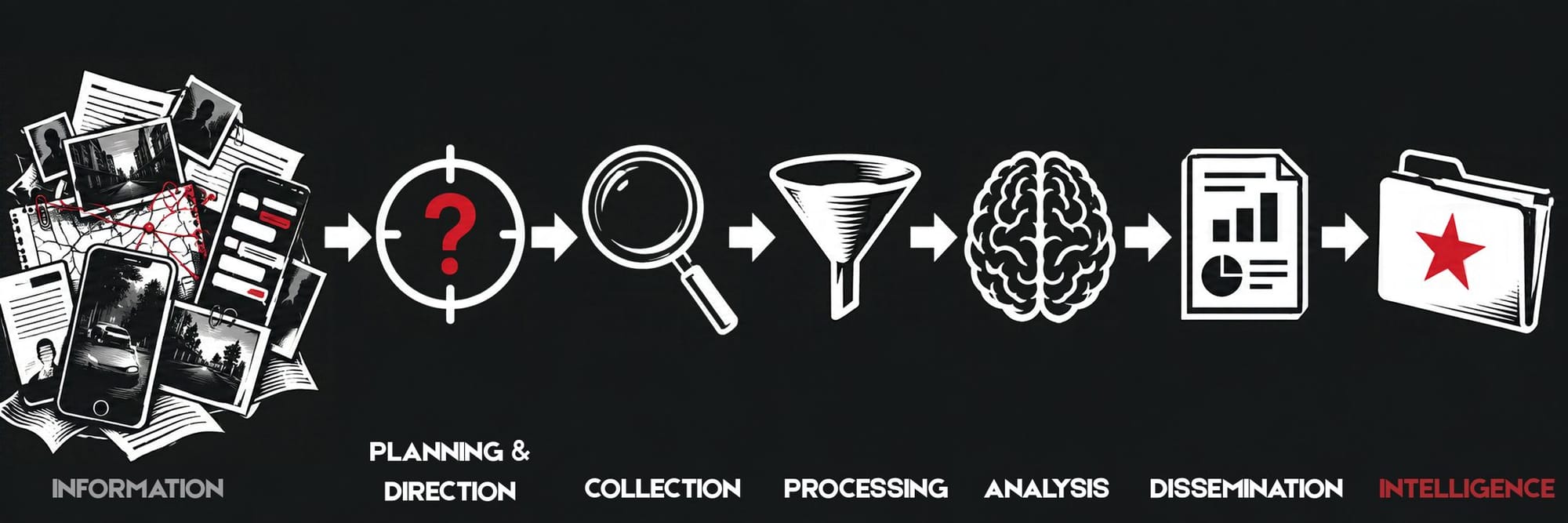
The process that turns information into intelligence is called the intelligence lifecycle, and I break it down phase by phase in The Intelligence Lifecycle Explained.
Where OSINT fits in the intelligence world
Intelligence is organized into collection disciplines, often called the "INTs," and each one is defined by where its information comes from. The U.S. Intelligence Community recognizes five, and OSINT is one of them. [2]
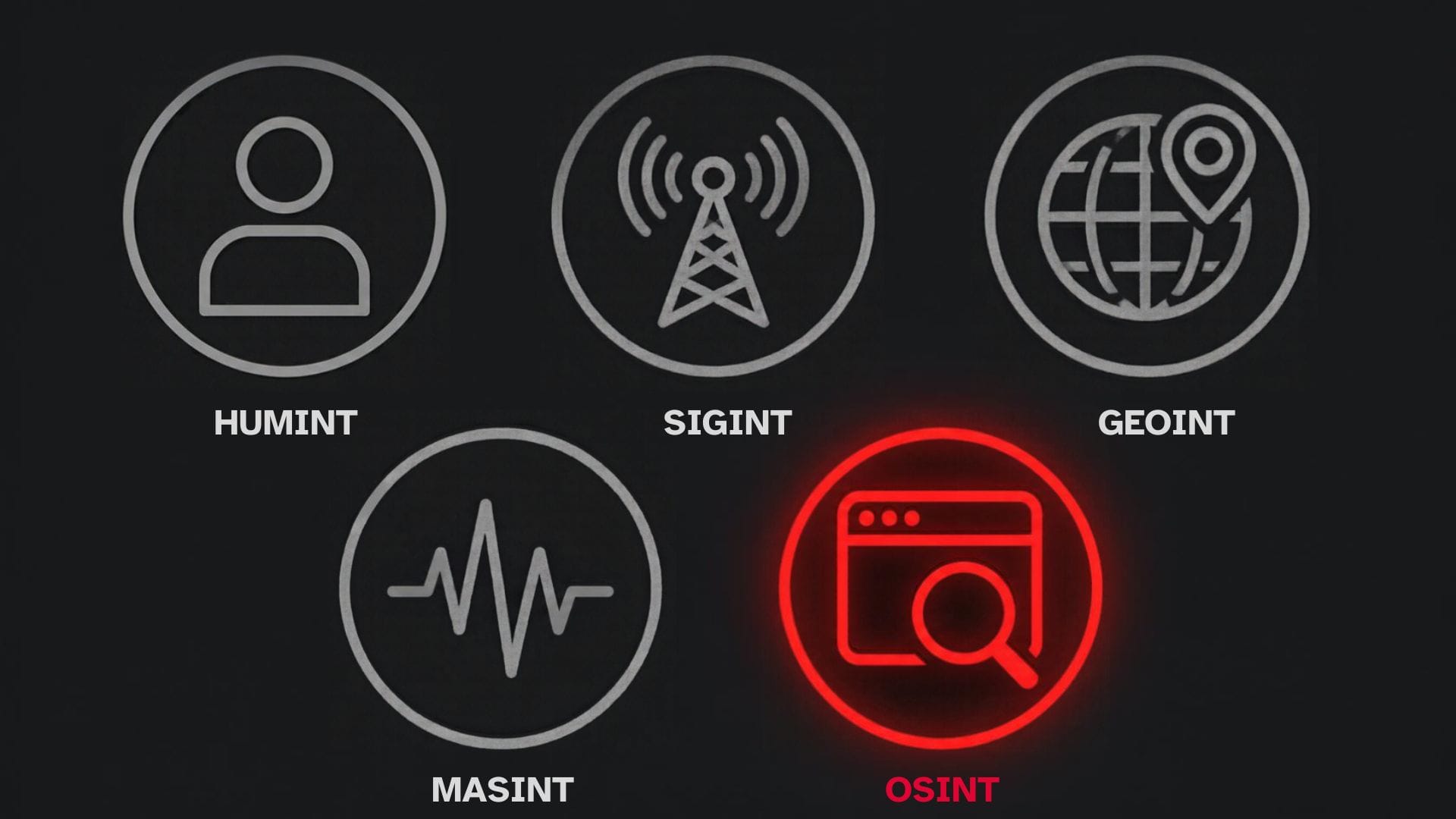
| Discipline | Stands for | Where the information comes from |
|---|---|---|
| HUMINT | Human intelligence | People: sources, debriefings, military attachés |
| SIGINT | Signals intelligence | Intercepted communications and electronic signals |
| GEOINT | Geospatial intelligence | Satellite and aerial imagery, maps, and location data (this includes imagery intelligence, or IMINT) |
| MASINT | Measurement and signature intelligence | Technical sensor data, such as radar, acoustic, or chemical signatures |
| OSINT | Open-source intelligence | Publicly and commercially available information |
You'll see other "INTs" online, like SOCMINT or CYBINT. Those aren't official collection disciplines, just informal labels for parts of the five above. Social media research, for example, falls under OSINT.
All-source analysts pull from every discipline to build the full picture. The IC OSINT Strategy goes a step further and calls OSINT "the INT of First Resort." [2]
Who uses OSINT
- Journalists verify footage from conflicts and breaking news.
- Intelligence analysts track threats, events, and organizations.
- Cybersecurity teams see what an attacker could learn about their company.
- Law enforcement and investigators develop leads and corroborate information.
- Nonprofits help locate missing persons and disrupt human trafficking.
- Businesses run due diligence on partners, vendors, and acquisitions.
- Everyday people protect their privacy and spot scams.
The core skills stay the same, but the questions change.
What OSINT is not
If you take one thing from this article, let it be this: OSINT has boundaries.
| OSINT is | OSINT is not |
|---|---|
| Using publicly or commercially available sources | Hacking, guessing passwords, or getting into private accounts |
| Research with a defined purpose | Stalking, harassing, or intimidating someone |
| Reporting findings to the person who needs them | Doxxing: posting someone's personal details to target them |
| Bound by law and ethics | "Anything goes because it's public" |
Laws vary by country and state, so before you practice on anything real, read Should I Be Doing This?
Is OSINT for you?
You don't need a cyber background, a badge, or a clearance to get started. People come into this field from journalism, the military, law enforcement, IT, research, and even stay-at-home parenting. What matters more are these traits:
- Curiosity that doesn't stop at the first search result
- Patience for reading, cross-checking, and reading again
- Comfort with uncertainty, including saying "I can't confirm that yet"
- Attention to detail, because a shadow or a reused username can break a case open
- A firm ethical line, and the discipline to hold it
If you want fast results and dramatic breakthroughs, this work will frustrate you. If you enjoy working through puzzles carefully and getting them right, you'll fit right in. And even if OSINT never becomes your career, knowing what's out there about you is the first step to protecting it.
Where to go next
- Start Here for the full map of the blog.
- So You Want to Get Into OSINT? for an honest look at what the work is like.
- Digital Disguises, Vol. 1 before you research anything real, so you can keep your research identity separate from your personal one.
Subscribe to get new challenges and articles in your inbox. I'll see you in the next one.
-Mrs. OSINT
Sources
- UN Office of the High Commissioner for Human Rights and Human Rights Center, UC Berkeley School of Law. Berkeley Protocol on Digital Open Source Investigations (HR/PUB/20/2), 2022.
- Office of the Director of National Intelligence and Central Intelligence Agency. The IC OSINT Strategy 2024-2026: The INT of First Resort, March 2024.